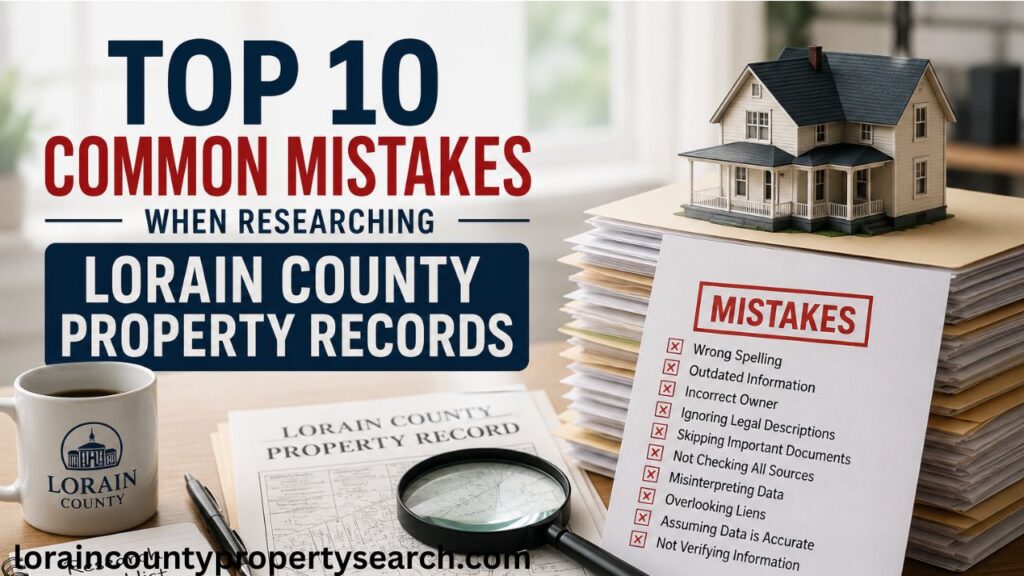
Accurate property research is the foundation of any successful real estate investment in Lorain County, Ohio. Whether you are a homeowner, a developer, or a potential buyer, navigating public records requires diligence. Many users unknowingly fall into traps that lead to financial or legal complications. By avoiding these 10 common pitfalls, you can conduct your land research with professional precision.
1. Relying Only on Address Searches
Searching by a street address can be misleading, especially with recent lot splits or new construction. Addresses in databases can be outdated.
Pro-Tip:
Always use the Parcel Identification Number (PIN). It is the unique identifier for your plot of land and ensures you are analyzing the exact legal boundary, not just a physical location.
2. Ignoring Deed Transfer History
A property’s deed history tells the story of its ownership and financial health. Always check the Transfer History tab in the county records.
- What to watch for:
Check the instrument type (e.g., Warranty Deed vs. Quitclaim Deed). Frequent transfers within a short period or ownership by a series of shell companies can be a red flag for legal title issues.
3. Misunderstanding Tax vs. Market Value
The Auditor’s appraised value is strictly for tax assessment purposes. It often lags behind real market trends. Never mistake the tax value for the price the property would command on the open market.
Action:
Use the tax record as a financial baseline, but use recent comparable sales (comps) to determine actual investment value.
4. Overlooking GIS Overlay Layers
The interactive GIS map is one of the most powerful tools in Lorain County. Most users only look at the base satellite photo.
Pro-Tip:
Always toggle the “Layers” menu to check for flood zones, wetlands, and soil types. A property that looks perfect on a photo might be restricted by local environmental protections that prevent building.
5. Skipping Board of Revision (BOR) History
Did you know property taxes can be appealed? If you see that a property has a history of successful tax appeals, it suggests the market value assessment might be contested. This is crucial if you are evaluating a property that seems over-assessed compared to neighboring lots.
6. Failure to Verify Zoning Ordinances
Before making an offer, confirm the specific zoning tier (e.g., Residential R-1 vs. Commercial C-1). Township master plans dictate what can and cannot be built. Setback requirements (how far a building must be from the street) vary significantly from one plot to the next.
7. Missing Hidden Special Assessments
Beyond standard property taxes, some lots carry Special Assessments. These are local charges for infrastructure improvements like sewage lines, new street lights, or sidewalk installation. These charges can quietly add thousands of dollars to your annual tax liability.
8. Relying on Third-Party Data
Sites like Zillow are excellent for browsing, but they often have data synchronization delays or missing tax details. Always verify legal documents, easements, and current owners directly through the official Lorain County Auditor’s or Recorder’s portals. Official government records are the “source of truth.”
9. Misinterpreting “Usable” Acreage
Total acreage in a record does not always mean “buildable” acreage. Look at the legal description to see if parts of the land are locked in drainage easements or utility corridors that you cannot develop. Always consult a surveyor if the land usage is unclear.
10. Neglecting the “Last Update” Date
Databases are updated regularly, but not instantly. Always check the “Last Update” timestamp on the Auditor’s summary screen. If the records haven’t been updated in months, verify recent transactions with the Recorder’s office before making financial commitments.
Efficiently handling property documents requires the right gear. For professionals, I highly recommend checking out these [Essential Office Tools] that help speed up the scanning and filing process.
Expert Research Checklist for Lorain County
To ensure you aren’t missing anything, follow this workflow before any real estate decision:
- Search by PIN, not just address.
- Review the GIS layers for environmental/zoning restrictions.
- Download the official tax summary from the Auditor’s portal.
- Cross-reference with the Recorder’s office for any active liens or deeds.
Frequently Asked Questions
Q: Can I rely on third-party real estate sites for legal property info?
No. Third-party sites are for browsing. Always confirm legal data (deeds, liens, assessments) through official Lorain County government portals.
Q: Why does my property tax differ from a neighbor’s with similar land size?
Taxes are based on appraised market value, which includes building age, property condition, and the assessment year. Neighbors may have had a different assessment timeline.
Q: What is a “Special Assessment”?
These are charges added to your tax bill for specific local improvements (like sewer or sidewalk upgrades) that benefit your specific parcel.
Q: How do I identify if my land is in a flood zone?
Use the official Lorain County GIS interactive map. Enable the “FEMA Flood Zone” layer to see if your land falls within regulated hazard areas.
Q: Where do I go to contest my property tax assessment?
You must file a petition with the Lorain County Board of Revision (BOR). It is helpful to bring records of neighboring property values as evidence.