Purchasing undeveloped acreage in Lorain County, Ohio, offers a unique opportunity for residential developers, agricultural investors, or individuals planning a custom build. However, raw land transactions require a deeper layer of research compared to standard residential home sales.
From analyzing local township zoning laws to estimating long-term property liabilities, conducting thorough due diligence is the key to protecting your investment capital. This resource breaks down the essential factors every land buyer must evaluate across Lorain County.
Classifying Undeveloped Property Types
Before entering a purchase contract, you must identify the infrastructure status of the parcel. The Lorain County Auditor and local utility providers generally categorize undeveloped acreage into three distinct tiers:
Raw Land
This refers to entirely untouched parcels with no existing vehicular access, cleared building envelopes, or nearby utility extensions. Purchasing raw land requires the highest upfront capital investment for site development.
Unimproved Property
Plots that typically feature basic road frontage or nearby mainlines (such as electricity or public water lines running along the street) but lack direct on-site hookups or cleared building pads.
Improved Lots
Construction-ready parcels that already feature established driveways, municipal tap-ins, public sewer access, or electricity drop boxes installed at the property line.
Legal and Environmental Due Diligence Checklist
To avoid costly legal entanglements or purchasing unbuildable soil, land buyers should cross-reference their target parcel with local municipality standards.
- Zoning Ordinances:
Municipalities like Avon, Amherst, or North Ridgeville maintain independent zoning maps. You must verify if the land allows single-family residential, commercial, or agricultural structures, along with specific setback rules. - Soil Percolation (Perc) Testing:
If public sewer access is unavailable, a certified perc test is mandatory to determine if the soil can support a private septic system. - GIS Boundary & Wetland Review:
Utilizing the Lorain County GIS mapping software helps identify whether portions of the acreage fall under protected environmental wetlands or designated flood zones.
Land Valuation: Conveyance Fees & Specialized Credits
The financial landscape of owning raw land involves different tax structures and closing costs compared to developed real estate.
Deed Transfer Fees
When raw land changes hands, the transaction triggers the standard Lorain County real property conveyance fee. This is a value-based tax calculated at $4.00 per $1,000 (0.4%) of the total sale price, which is traditionally deducted from the seller’s proceeds at closing.
Current Agricultural Use Value (CAUV)
For larger tracts of land dedicated strictly to commercial farming, timber logging, or agricultural production, owners can apply for the CAUV program through the Lorain County Auditor. This program recalculates property taxes based on agricultural income potential rather than market value, offering substantial ongoing tax relief.
Essential Safeguards Before Closing a Land Deal
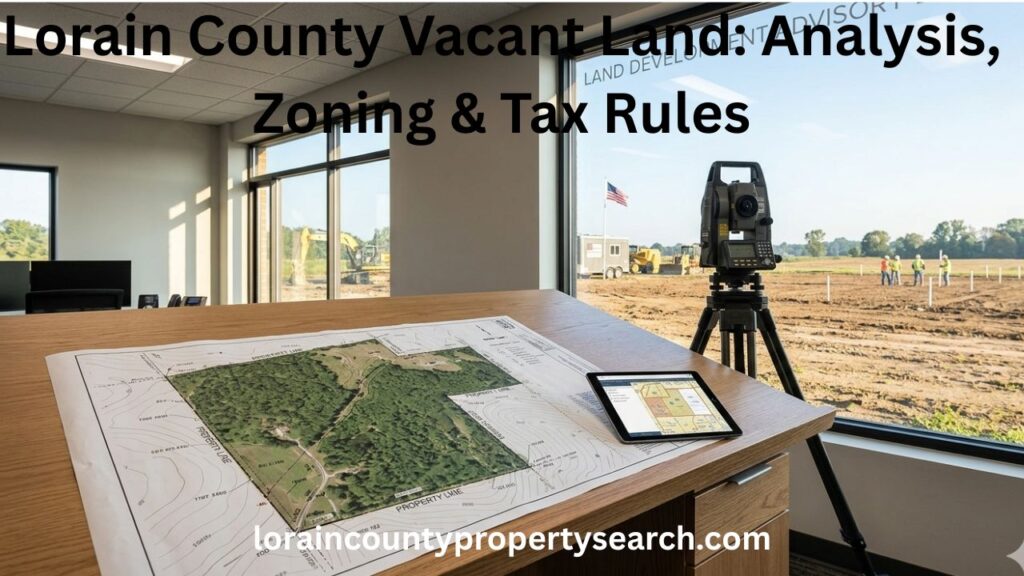
- Secure an Independent Survey:
Never rely solely on old plat maps. Hire a licensed Ohio surveyor to physically stake the iron pins and define the exact acreage boundaries. - Review Deed Easements:
Inspect the title commitment report for any hidden utility easements, shared driveway agreements, or right-of-way paths that could restrict where you can build. - Account for Site Prep Budgets:
Always factor in the secondary costs of land clearing, tree removal, excavation, and municipal building permits before finalizing your financing.
FAQs
Q1: Where do I find the official zoning classification for a plot in Lorain County?
Because zoning is governed at the local level, you must contact the specific township trustees or city building department where the parcel resides to review their official land-use charts.
Q2: Is a DTE 100EX form required for vacant land transfers?
The DTE 100EX form is only utilized if the land transfer qualifies for a legal tax exemption such as a gift between spouses, an inheritance transfer, or a deed change ordered by a divorce court.
Q3: Can I build a home on land that fails a soil perc test?
If the soil fails a traditional perc test, standard septic tanks cannot be installed. You would need to consult an environmental engineer to design a more expensive, specialized alternative system (such as a mound system) approved by the health department.
Q4: How do I verify if a piece of land has public water or needs a well?
You should contact the Lorain County Rural Water Authority (LORCO) or the local city water department with the specific parcel number to confirm if a water main runs adjacent to the property line.
Q5: Can I buy vacant land through the Lorain County Land Bank?
Yes. The Land Bank sells foreclosed or unused parcels. You must submit a Vacant Land Application describing your intended land use.
Q6: What happens if the vacant land I purchase has back taxes owed?
In Ohio, property taxes attach to the land itself, not the owner. If you close on a parcel with delinquent back taxes, those financial liens become your legal responsibility. To prevent this, always ensure your title company performs a complete title search and clears all outstanding county tax liens before deed transfer.
Q7: Can I place a mobile home or RV on raw land in Lorain County?
This depends strictly on the local township’s specific zoning regulations. Many residential zones across Lorain County prohibit temporary RV living or manufactured homes, while some agricultural districts permit them under strict size and foundation permits. Always consult the local zoning inspector before purchasing land for this purpose.