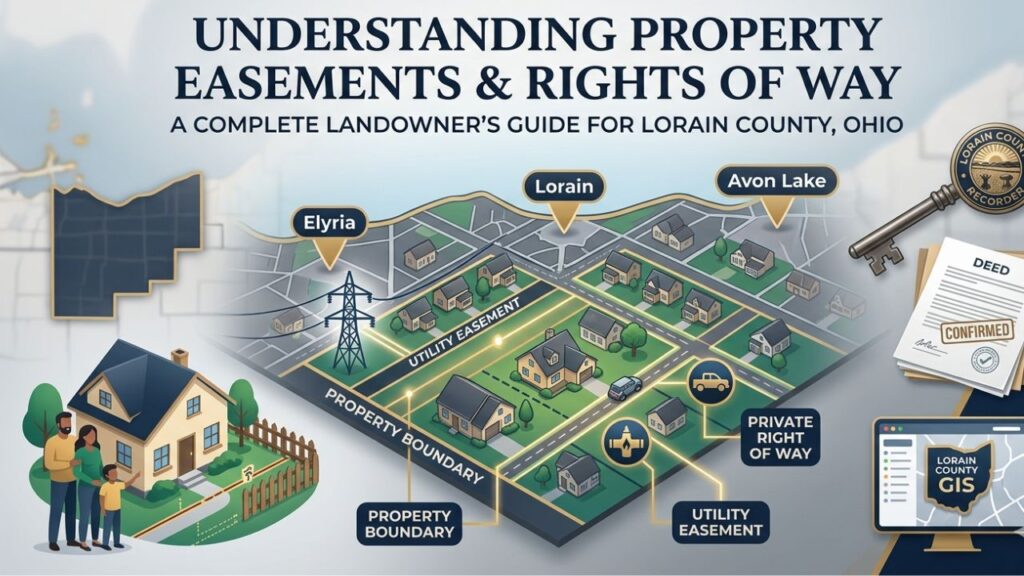
Owning property in Lorain County whether it’s a historic home in Elyria, a lakefront lot in Vermilion, or a suburban spread in Avon comes with a specific set of legal realities. One of the most misunderstood aspects of real estate ownership is the “Easement.”
Many homeowners are surprised to find that a utility company or a neighbor has a legal right to access their land. Understanding these “Rights of Way” and easements is not just about legal jargon; it’s about knowing your rights, protecting your property value, and avoiding costly construction mistakes.
What is an Easement? (The Simple Definition)
In Lorain County legal terms, an easement is a “non-possessory” interest in land. This means someone else has the legal right to use a specific part of your property for a specific purpose, but they do not own it.
These rights are usually recorded at the Lorain County Recorder’s Office and are attached to the property deed. This means when you sell the house, the easement typically stays with the land for the next owner.
Common Types of Easements in Lorain County
Not all easements are created equal. Depending on where you live in the county, you might encounter different types:
1. Utility Easements (The Most Frequent)
Almost every residential parcel in Lorain County has a utility easement. Companies like FirstEnergy, Columbia Gas, or the Lorain County Rural Water Authority need access to maintain power lines, gas pipes, and water mains.
- The Constraint: You generally cannot build permanent structures like a swimming pool, a large shed, or a brick wall over these areas.
2. Private Easements
These are agreements between two private neighbors. A common scenario in the more rural parts of Amherst or Oberlin is a Shared Driveway Easement, where one neighbor must cross another’s land to reach a public road.
3. Easements by Necessity
In Ohio, landlocked property is rare because the law allows for “Easements by Necessity.” If a piece of land has no access to a public street, the court may grant the owner a right of way through an adjacent property.
4. Prescriptive Easements (The 21-Year Rule)
Ohio law is unique. If someone uses a portion of your land openly and continuously without your permission for 21 years, they may legally claim a “Prescriptive Easement.” This is why it is vital for Lorain County owners to check their boundaries via the Lorain County GIS map regularly.
Rights of Way: What You Need to Know
While people often use these terms interchangeably, a Right of Way is actually a specific type of easement. It is the legal right to pass through a property.
| Feature | Property Easement | Right of Way |
| Typical Use | Laying pipes, cables, or drainage. | Driving, walking, or public transit. |
| Who Uses It? | Utility companies or specific neighbors. | The general public or local municipality. |
| Owner Control | You can use the land (e.g., garden) if it doesn’t block access. | You cannot block or obstruct the path at all. |
How Easements Impact Your Property Value
Many homeowners worry that an easement will lower their home’s value. The truth is:
- Neutral Impact: Standard utility easements along the edge of a property rarely affect value because they are common.
- Negative Impact: A large high-voltage power line easement or an oil pipeline running through the middle of a backyard can decrease market appeal and limit where you can build.
The Risk of Building Without Checking Easements
Before you start a DIY project or hire a contractor in Lorain County, you must verify your easement status.
- Forced Removal: If you build a garage over a city sewer easement, the city of Lorain or Elyria can legally demand you tear it down at your own expense if they need to access the pipes.
- Title Issues: If you try to sell your home and the buyer’s title search finds an encroachment (like a fence on a neighbor’s right of way), it can kill the deal.
- Permit Rejection: The Lorain County Building Department will often reject permit applications if your site plan shows a structure on a recorded easement.
How to Locate Easements on Your Lorain County Property
Don’t rely on old fences or word-of-mouth. Follow these official steps:
- Step 1: Check the Lorain County GIS:
The Lorain County GIS Department provides an online map where you can see parcel lines and often identify public rights of way. - Step 2: Review Your Deed:
Visit the Lorain County Recorder’s Office (225 Court St, Elyria) to get a copy of your current deed. Easements are usually listed in the “Legal Description” section. - Step 3: Call 811 Before You Dig:
This is a free service in Ohio. They will mark the underground utility lines on your property so you can see the easements in real-time. - Step 4: Professional Survey:
If there is a dispute with a neighbor, hiring a licensed Ohio surveyor is the only way to get a legally binding boundary map.
Official Lorain County Contact Information
If you need to verify an easement or file a new deed, you can reach out to the local departments directly:
- Lorain County Recorder:
225 Court St, Elyria, OH 44035 | Phone: (440) 329-5148 - Lorain County Auditor:
225 Court St, Elyria, OH 44035 | Phone: (440) 329-5207 - Call Before You Dig (Ohio811):
Dial 8-1-1 or 1-800-362-2764
Conclusion
Understanding easements and rights of way is a fundamental part of being a responsible property owner in Lorain County. Whether you are dealing with a simple utility line or a complex shared driveway, knowing where these legal rights lie can save you thousands of dollars in legal fees and construction mistakes. Always consult the Lorain County Auditor and Recorder records to stay fully informed about your land’s status.
Frequently Asked Questions
1. Can I cancel an easement on my property?
It is very difficult. An easement can only be terminated if both parties sign a legal “Release of Easement,” or if the easement holder “abandons” it (which requires legal proof).
2. Can I plant trees on a utility easement?
You can, but it’s risky. If the utility company needs to repair a line, they have the legal right to remove or trim the trees without compensating you.
3. Does an easement mean the county owns my land?
No. You are still the legal owner of the land and are responsible for paying property taxes on the entire parcel, including the easement area.
4. What if my neighbor is using my land without an easement?
You should address this immediately. If you allow it to continue for 21 years, they may gain a legal “Prescriptive Easement” under Ohio law.